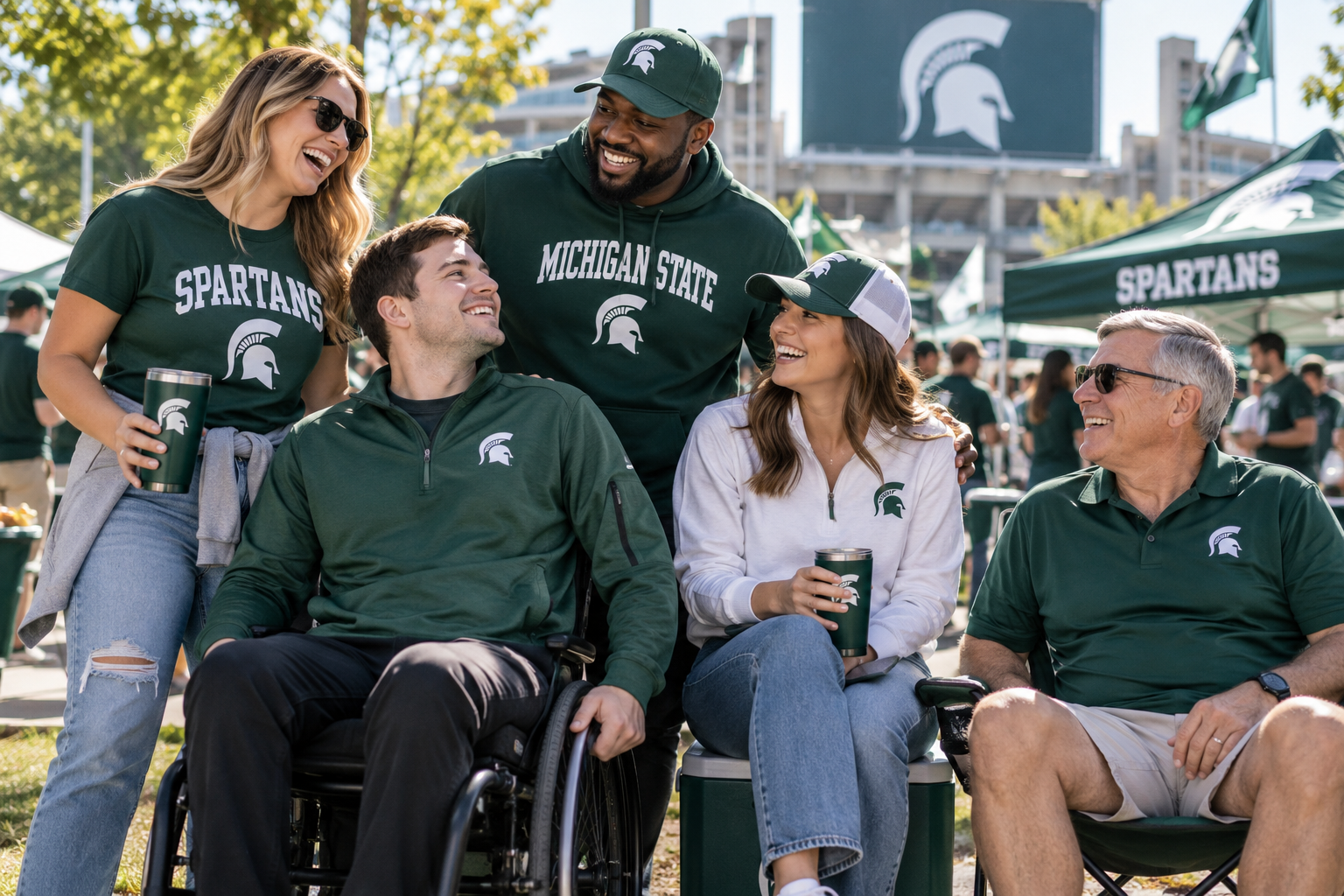
Walk into a college bookstore. Search your favorite university's online store. Look through the apparel available to students, alumni, parents, and fans. You'll probably find: T-shirts. Hoodies. Quarter-zips. Jackets. Polos. Sweatshirts. Hats. Performance apparel. Vintage designs. Game-day collections. Dozens—sometimes hundreds—of ways to wear your school pride. Now ask one more question: How many of those products were designed for someone who has difficulty using traditional clothing? The answer has historically been much smaller. Sometimes there may be a few options. Sometimes none. And that's the problem Every Collegiate Apparel was created to help address. Adaptive apparel already exists. Collegiate apparel obviously exists. People with disabilities have always been students, alumni, parents, employees, and fans. Yet bringing those three realities together— adaptive design, authentic collegiate identity, and meaningful consumer choice —has been surprisingly difficult. We're working to change that. Because college pride doesn't belong to one type of body. Every Ability. Every Moment. Every School. First, What Is Adaptive Apparel? Adaptive apparel is clothing designed or constructed to address certain dressing, mobility, dexterity, comfort, or access needs. Exactly what that means varies enormously from person to person. One individual might have difficulty manipulating small buttons. Another may dress primarily while seated. Someone may have limited arm movement. Another person may need assistance from a caregiver. Someone may find pulling a traditional shirt over their head difficult. Another person may need different access points in a garment. Adaptive clothing attempts to address needs like these through thoughtful construction. What Makes Clothing "Adaptive"? There isn't one universal adaptive feature. Depending on the garment and intended wearer, adaptive design may include things such as: Alternative closures Magnetic or easier-access fasteners Wider openings Alternative entry points Seated-wear construction Modified garment lengths Adjusted waistbands Repositioned seams Simplified dressing access Other construction modifications intended to improve ease of dressing or wear And here's one of the most important things to understand: Adaptive clothing doesn't necessarily have to look adaptive. The function may be different. The style doesn't have to be. So What Is Adaptive Collegiate Apparel? Take those adaptive design principles and combine them with authentic university apparel. That's adaptive collegiate apparel. It can allow someone who needs adaptive construction to wear: Their school colors. Their university identity. Their favorite design. Their alumni pride. Their family tradition. Their fandom. Just like everyone else. That sounds incredibly simple. In many ways, it should be. But historically, it hasn't been. College Apparel Is About Much More Than Clothing To understand why this matters, you have to understand what collegiate apparel represents. A Michigan State shirt isn't simply a green shirt. An Alabama shirt isn't simply crimson. An Arizona State shirt isn't simply maroon and gold. A Towson shirt isn't simply black and gold. The colors mean something because the school means something. Collegiate apparel can represent: Where you studied. Where your child attends school. Where your parents met. The team your family has supported for generations. The place where you built lifelong friendships. A Saturday tradition. A diploma. A memory. A community. That's why the lack of adaptive collegiate apparel matters. The issue isn't simply that someone couldn't find a different kind of shirt. They may have had fewer opportunities to wear a symbol of an identity they already possessed. People With Disabilities Have Always Been Part of College Communities This is worth stating clearly. Disabled people aren't new to universities. They aren't new to sports fandom. They aren't new to alumni associations. They aren't new to tailgates. They aren't new to families that pass school traditions from one generation to another. People with disabilities are: Students. Alumni. Faculty. Staff. Parents. Grandparents. Children. Donors. Fans. Season-ticket holders. Community members. Some have lifelong disabilities. Others acquire disabilities later. Some use wheelchairs. Some use walkers. Some have limited dexterity. Some need dressing assistance. Some have disabilities you would never know about by looking at them. They've always been part of collegiate communities. The apparel market hasn't always reflected that reality. Why Has Adaptive Collegiate Apparel Been So Hard to Find? There's no single explanation. It's the result of several challenges coming together. Challenge #1: Adaptive Apparel Has Historically Been a Smaller Category Traditional apparel is built around scale. Manufacturers produce enormous quantities of standard garment constructions. Retailers understand them. Decorators know how to print them. Customers recognize them. Supply chains are established. Adaptive apparel has historically represented a much smaller portion of the clothing market. That can mean fewer: Garment styles. Colors. Suppliers. Sizes. Blank products. Production options. Retail channels. When fewer adaptive blanks are available to begin with, creating a broad collegiate assortment becomes more complicated. Challenge #2: Collegiate Apparel Isn't Just Any Apparel You can't simply take a university's trademarks and put them on a shirt because you want to sell school merchandise. Authentic collegiate apparel operates within licensing systems. Schools protect their: Names. Logos. Mascots. Marks. Colors. Brand standards. Licensed products must follow the applicable university and licensing requirements. That's important. Fans should be able to trust that officially licensed merchandise represents their university appropriately. But it also means adaptive collegiate apparel sits at the intersection of adaptive product development and collegiate licensing . That's a more complicated intersection than simply creating a generic adaptive T-shirt. Challenge #3: The Adaptive Garment Still Has to Work With Decoration Here's something consumers understandably don't think about very often. An adaptive garment can be constructed differently from a traditional garment. That's the point. But different construction can affect how it is: Printed. Embroidered. Positioned on equipment. Handled during production. Finished. Packaged. A decoration process built around standard T-shirts may not translate perfectly to every adaptive garment. So creating adaptive collegiate apparel isn't only a design challenge. It can also be a production challenge. Challenge #4: Smaller Demand Can Create a Supply Problem There's a frustrating cycle that can happen in underserved markets. A retailer says: "We don't carry many adaptive products because demand is low." But customers say: "We don't buy much adaptive collegiate apparel because we can't find it." Which came first? If customers have rarely been offered meaningful choices, historical sales data can't necessarily tell us what the market could become. Availability affects demand. Visibility affects awareness. Choice affects purchasing. You can't accurately measure interest in a category people haven't been given a meaningful opportunity to shop. Challenge #5: Adaptive Has Too Often Been Treated as a Separate Market This may be the biggest philosophical issue. Traditional apparel over here. Adaptive apparel somewhere else. Traditional fashion. Adaptive function. Mainstream customers. "Special needs" customers. That separation can influence everything from product development to retail presentation. Every Collegiate Apparel is built around a different question: Why are we separating people who already belong to the same school community? What If We Organized Apparel Around the School Instead? Imagine shopping for your university. You find a design you love. Then you choose the option that works for you. Traditional construction? Great. Adaptive construction? Great. Different garment? Great. The organizing principle isn't: "Which kind of person are you?" It's: "Which school are you proud to represent?" That's the shift we're interested in. Traditional and Adaptive Should Be Able to Exist Together This is fundamental to the Every Collegiate model. We're not trying to replace traditional collegiate apparel. Most people will continue wearing traditional garment constructions. Some people with disabilities will too. We're trying to expand the choices. Traditional and adaptive apparel can exist: Under the same school. Within the same collection. Using the same school colors. Sharing designs where practical. Representing the same identity. That's what inclusive collegiate apparel can look like. Adaptive Doesn't Mean "For Wheelchair Users" This misconception needs to disappear. Wheelchair users are an important part of the adaptive apparel community. They're not the entire community. Adaptive clothing may be useful to people with: Limited dexterity. Limited range of motion. Limb differences. Mobility limitations. Neuromuscular disabilities. Age-related changes. Temporary injuries. Dressing-assistance needs. And many other circumstances. At the same time, not every person with a disability needs or wants adaptive clothing. A wheelchair user might prefer a traditional T-shirt. A person without a visible mobility device might strongly benefit from adaptive construction. The customer should have the choice. Adaptive Describes the Garment—not the Person This distinction is central to how we think. Adaptive is a product characteristic. It's not someone's identity category in a retail system. A person shouldn't walk into a collegiate store and become: "The adaptive customer." They're an Alabama fan. A Towson alum. An Arizona State parent. A Michigan State student. A college sports fanatic. A proud grandparent. A future freshman. A customer. Adaptive simply describes one possible way their clothing can be constructed. Function Shouldn't Require Giving Up Style Historically, products designed around disability have sometimes prioritized function so heavily that aesthetics became secondary. Function matters. If a garment doesn't work, we've failed. But people with disabilities still care about: Style. Fit. Color. Trends. Identity. Design. Choice. People don't stop wanting to look good because dressing becomes more difficult. Adaptive collegiate apparel should be apparel someone wants to wear , not merely apparel they're grateful exists. Same Design Doesn't Always Mean Identical Garment There's an important nuance here. Our goal isn't to pretend adaptive and traditional garments are always identical. They're not. Different construction can mean: Different seams. Different panels. Different proportions. Different decoration areas. Different available colors. Different materials. Different manufacturing requirements. So the goal isn't: "Make absolutely everything identical." The better goal is: Preserve the shared identity wherever possible. Same school. Coordinated design. Same spirit. Different construction when needed. Choice Is More Inclusive Than Assumption We don't want to decide what someone needs based on how they look. That's why choice matters so much. A genuinely inclusive shopping experience might allow customers to consider: Traditional products. Adaptive products. Different fits. Different styles. Different designs. Different price points. Different levels of accessibility. Then decide for themselves. Inclusion shouldn't replace one assumption with another. Why Not Just Create a Separate Adaptive Brand? Because someone who needs adaptive clothing doesn't suddenly stop being part of their university. If you're a Spartan, you're a Spartan. If you're a Tiger, you're a Tiger. If you're a Sun Devil, you're a Sun Devil. The garment construction isn't the primary identity. The school is. That's why we believe adaptive collegiate apparel belongs within collegiate apparel—not off in an entirely separate universe. This Is Also a Representation Problem Product availability is only part of the challenge. Look at traditional collegiate marketing. Who do you see? Students. Athletes. Alumni. Families. Friends. Tailgaters. Fans. Now ask: How often do you see disabled people simply included as ordinary members of those groups? Representation matters because imagery teaches us what a community looks like. If disabled fans only appear when the advertisement is specifically about disability, we're still separating the experience. Sometimes the strongest representation is simply: A wheelchair user at the tailgate. Wearing a great shirt. Laughing with friends. And nobody treating it as extraordinary. We Don't Need "Inspirational" Customers People with disabilities don't need to become inspirational stories simply because they purchased a college shirt. They can simply be customers. That matters. Representation can become uncomfortable when a person's disability automatically becomes the entire narrative. Someone might want adaptive apparel because: They love the design. They love the school. They need the construction. End of story. That's normal. And normalizing disability within collegiate apparel is part of the larger goal. Adaptive Apparel Can Affect Caregivers Too Clothing accessibility doesn't only affect the wearer. Some people dress independently. Others receive assistance. For caregivers, certain traditional garment constructions can make dressing: More difficult. More time-consuming. Physically demanding. Uncomfortable for the wearer. Thoughtful adaptive construction can sometimes improve the dressing experience for both people. That's another reason adaptive apparel should be understood as practical design—not novelty clothing. College Pride Lasts Longer Than College There's another reason this category matters. University communities are multigenerational. Someone might become a Michigan State fan at 8. Attend the university at 18. Graduate at 22. Bring their children to campus at 40. Return for reunions at 60. Still wear green at 80. Bodies change over a lifetime. Mobility changes. Dexterity changes. Dressing needs can change. School identity doesn't necessarily change with them. Collegiate apparel should be capable of serving people across more stages of life. Adaptive Design Can Benefit More People Than Expected One of the interesting things about accessible design is that features developed around specific barriers can sometimes prove useful to broader groups. Ease of dressing can matter to: People with disabilities. Older adults. People recovering from injuries. Caregivers. People experiencing temporary mobility limitations. The original need may be disability-related. The usefulness can extend further. That's one reason accessibility can encourage better design thinking overall. Why Every Collegiate Apparel Exists Every Collegiate Apparel grew from a simple realization. The idea behind Every Spartan™ shouldn't have to stop with one university. The question was bigger: Why shouldn't this exist for more schools? Why shouldn't a disabled Alabama fan have meaningful choices? Or a Towson alum? Or an Arizona State student? Or a fan at the next university we haven't reached yet? That's how Every Collegiate Apparel began to take shape. Not as a completely separate mission. As an expansion of the same one. We're Building School by School There's an important reality behind this vision. You can't simply announce: "We now make apparel for every university." Collegiate licensing doesn't work that way. Each university has its own identity. Its own standards. Its own relationships. Its own licensing decisions. So Every Collegiate Apparel is being built deliberately: School by school. Relationship by relationship. License by license. Collection by collection. That takes longer than simply printing names on shirts. We think doing it correctly matters. Partnerships Matter Because Nobody Builds a New Category Alone Expanding adaptive collegiate apparel requires expertise across different areas. Product construction. Accessibility. Manufacturing. Decoration. Licensing. University relationships. Retail. Marketing. Lived experience. That's why collaboration is central to how we're approaching growth. Every Collegiate Apparel is proud to serve as the Exclusive Collegiate Partner for GAMUT Certified Adaptive Apparel. That relationship helps reinforce something we believe strongly: Accessibility should be considered intentionally—not simply added to the marketing after a product has already been created. Lived Experience Matters Too Adaptive apparel shouldn't be designed entirely around assumptions about disability. People who actually live with disabilities understand details others may never consider. Where does fabric bunch while seated? Which movements are difficult? What requires assistance? What feels uncomfortable? What looks good from a seated position? What makes dressing easier? What "helpful" feature actually creates another problem? Those perspectives matter. Not because every disabled person has the same experience. They absolutely don't. But because inclusive product development becomes stronger when lived experience is part of the conversation. The Goal Isn't a Bigger "Adaptive Section" This may be the most important point in this entire article. Success isn't: Building the world's biggest separate disability section. Our vision is different. We want adaptive collegiate apparel to become an expected part of collegiate apparel. Not hidden. Not separated. Not treated as unusual. Imagine someday shopping your favorite university collection and seeing: Traditional. Adaptive. Different fits. Different styles. Different options. No dramatic announcement necessary. Just choices. What Would Normalization Look Like? It would look like a university fan wearing adaptive apparel and nobody thinking: "That's adaptive clothing." They'd think: "Great shirt." It would look like traditional and adaptive products appearing in the same collection. It would look like disabled and nondisabled models appearing together. It would look like school pride first. It would look like retailers understanding adaptive construction as another product option. It would look like someone with a disability not having to search the internet wondering: "Does anyone make college apparel for me?" That's normalization. Why Has It Been So Hard to Find? So let's return to the question in the title. Why has adaptive collegiate apparel been difficult to find? Because several systems have historically needed to connect: Adaptive garment development. Manufacturing. Decoration. Distribution. Collegiate licensing. Retail. Accessibility expertise. Marketing. Consumer awareness. And representation. When those systems operate separately, the customer sees the gap. Every Collegiate Apparel exists because we believe that gap can become smaller. This Isn't About Creating a Lesser Version Adaptive apparel shouldn't be: The consolation product. The medical-looking product. The product hidden at the bottom of the website. The design nobody else wanted. The single shirt offered so a company can say it has an adaptive option. People deserve better. The goal should be products that are: Functional. Authentic. Stylish. Licensed where applicable. Connected to the same school identity. And worth choosing. We Also Need to Be Careful With the Word "Every" Our name sets a big standard. Every Collegiate Apparel. And our motto sets an even bigger one: Every Ability. Every Moment. Every School. Does that mean we currently serve every school? No. Does it mean one garment can accommodate every disability? No. Does it mean we've solved every accessibility challenge? Absolutely not. "Every" is the direction. It's the question we keep asking. Who isn't being served? What option is missing? What barrier can we address? What school comes next? How can the experience become more inclusive? We're building toward "every." The Future Should Feel Remarkably Ordinary Here's what success looks like to us. A family is getting ready for a college football game. One person grabs a traditional T-shirt. Another grabs an adaptive version. Someone else puts on a hoodie. Another wears a hat. Everyone gets ready. Everyone leaves. Everyone arrives at the tailgate. And nobody needs to have a philosophical discussion about inclusion. They're just fans. Wearing their school. Together. That's the future we're working toward. Different Construction. Same College Pride. Adaptive collegiate apparel isn't about creating a new kind of college fan. Those fans already exist. It's about giving more of them choices that reflect who they've always been. Students. Alumni. Parents. Children. Employees. Fans. People with disabilities. People without disabilities. People whose needs may change over time. Different bodies. Different clothing needs. Different schools. The same desire to belong. The industry has spent decades creating thousands of ways for people to wear their college pride. We think it's time to ask whether enough people have been included in those choices. And then do something about it. Every Ability. Every Moment. Every School. Frequently Asked Questions What is adaptive collegiate apparel? Adaptive collegiate apparel combines university or college identity with clothing construction intended to address certain dressing, mobility, dexterity, comfort, or access needs. The exact adaptive features vary depending on the garment. What makes a piece of clothing adaptive? Adaptive features can include alternative closures, easier-access fasteners, wider openings, seated-wear construction, modified lengths, adjusted waistbands, alternative entry points, repositioned seams, and other construction changes. Is adaptive collegiate apparel only for wheelchair users? No. Wheelchair users are only one part of the potential adaptive-apparel market. People with many different disabilities, mobility needs, dexterity limitations, dressing-assistance needs, or temporary physical limitations may benefit from adaptive construction. Do all people with disabilities need adaptive apparel? No. Many disabled people wear traditional clothing comfortably. Inclusive apparel is about creating additional options rather than deciding what someone needs based on disability. Why can't companies simply put college logos on adaptive shirts? Collegiate trademarks are protected and generally require appropriate licensing and approval for commercial merchandise. Creating authentic collegiate apparel therefore involves both suitable garments and the applicable licensing process. Does adaptive apparel have to look different from traditional apparel? Not necessarily. Construction differences may sometimes affect fit, decoration, or available styles, but adaptive apparel can still share the same visual identity, school colors, and coordinated designs as traditional apparel. Why offer traditional apparel if Every Collegiate Apparel is focused on inclusion? Because inclusion means choice. The Every Collegiate approach is designed around traditional and adaptive apparel existing together , serving one collegiate community rather than separating people into different brand identities. Does Every Collegiate Apparel currently serve every university? No. Every Collegiate Apparel is expanding school by school through the appropriate university relationships and licensing processes. "Every" represents the direction and mission of the brand, not a claim that every school is currently available. What is GAMUT's relationship with Every Collegiate Apparel? Every Collegiate Apparel is the Exclusive Collegiate Partner for GAMUT Certified Adaptive Apparel. Internal Linking Suggestions Introducing Every Collegiate Apparel: Every Ability. Every Moment. Every School. What Is Adaptive Apparel? Adaptive Apparel vs. Traditional Apparel: What's the Difference? Why Representation Matters in Collegiate Apparel Why Traditional and Adaptive Apparel Belong in the Same Collection Our Schools Our Mission Accessibility & Inclusion Every Spartan™ Call to Action Think about your favorite university. Now imagine its apparel store with more choices. Not a separate identity for people with disabilities. Not a token adaptive product. Not a hidden section someone has to know how to find. Just great collegiate apparel designed for more people. That's what Every Collegiate Apparel is working to build. School by school. Collection by collection. Relationship by relationship. If there's a university you'd like to see become part of the Every Collegiate mission, we want to hear from you. And if you wear adaptive apparel—or help someone who does—we especially want to hear what you wish collegiate apparel companies understood. Because building something more inclusive begins with listening to the people it's intended to serve. 🎓 Every Collegiate Apparel Every Ability. Every Moment. Every School. Stay Connected Enjoyed this article? Check back on the first and third Tuesday of every month for stories about adaptive apparel, traditional collegiate apparel, accessibility, representation, licensing, school pride, and the continued growth of Every Collegiate Apparel . We're building this differently. Not a separate college experience for people with disabilities. More ways for people to participate in the same one. 🎓 Every Collegiate Apparel Every Ability. Every Moment. Every School. Reader Question If your favorite university offered traditional and adaptive versions of the same collegiate designs side by side, what product would you want to see first—a T-shirt, sweatshirt, hoodie, jacket, or something else?